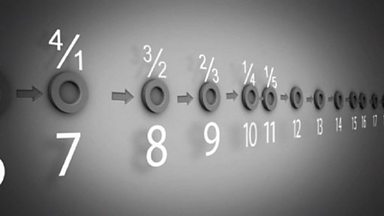
Infinity is the
concept that has puzzled mathematicians and thinkers alike for years. And this
continues and will continue for the succeeding years. Too many questions out of
curious minds that are needed to feed with answers, and eventually reveal the underlying
truth regarding this ambiguity.
But
really, what is infinity? In mathematics, infinity is simply defined as something not finite, hence it is endless. Mathematicians have defined “infinity” very
closely but not exactingly. The notion for this can be considered as profoundly
outside the human ability to understand. Even so, this has not stopped
mathematicians from solving and finding certainty. After all, the hunger
to explore and delight in discovery is what makes us human- living and
surviving.
The fourth episode of
the Story of Maths entitled “To Infinity and Beyond” is an existing example of
the saying “last but not least”. This final installment talks about the core
study and highlights of 20th century
mathematics that has started with the assembly of International Congress of
Mathematics in Sorbonne, Paris during 1900. One of the leading mathematicians
of his generation, David Hilbert, has outlined a list of 23 unsolved problems
(at that time in) which he called upon the attention of his colleagues. He
revealed vital questions that opened areas of research that has spanned
different branches of mathematics for the future generation.
Hilbert’s problems
were highly influential for the 20th century study of mathematics. The
problems overlapped several areas of mathematics; involving set theory,
geometry, arithmetic, algebra, variable calculus and many more. Some of these
were direct and thus immediately solved. Some problems, on the other hand, were
vague and expansive that until now they still remain unresolved.
One of the theories
(problems) needing for proof was proposed by Georg Cantor, a German
mathematician, whom was the first to give mathematical accuracy and precision
to the concept of infinity; and provided different types and sizes of infinities
through his Continuum Theory. Another problem that had confused mathematicians
during those times was regarding the orbits of planets in our solar system.
This has led to the basis for Chaos Theory by Henri Poincaré, a French
mathematician. Observing systems with a multiplicity of variables, this theory
had been a great function in studying climatic conditions and applications in
medicine. Further, showing any logical system that would result to true but
cannot be proved statements, as done by an Austrian mathematician in the name
of Kurt Gödel had revealed uncertainty through his Incompleteness Theorem.
Undeniably,
mathematics is not like a complete textbook as being taught and learned in
schools. The subject that was once been defined had evolved through history
became into the greatest abstract ideas that the human mind has encountered.
Among all of these abstractions, uncertainties and infinities, the study of
math will never be ended. Every proved theory would just lead into creation of
other theories; unanswered questions into answers and answered ones to be
questioned logically. Scholars and even ordinary people like math's challenges
and at the same time its clarity- the point when you know when you are right!
Finding a correct solution to a problem is not just satisfying, but at the same
time exciting.
After watching and
completing the documentary series "Story of Maths" here is my brief
generalization:
The ability to count,
compute, measure, study shapes and motions, and use
numerical relationships by logical reasoning with a bit of abstraction, are the
supremely significant among mankind’s achievements. Mathematics is not the
creation of a single person but the product of gradual and social evolution. It
all started as providing practical solutions for everyday problems for as far
as written records exist. The Greeks then first used logic in making
generalizations. On the other part of the world, most notably in China, India
and other Muslim places, mathematics continued to develop. Until the 17th to 19th centuries mathematicians have started
to take mathematics into a higher level. The 20th century study of this field was even
more advanced; giving rise to technologies and innovations that continues to
the present day.
The study of
mathematics is not just mystifying because some of us find it too complex to
fathom. It is the basis of the universe, allowing us to fully understand the
physical world.

No comments:
Post a Comment