Friday, January 31, 2014

To Infinity and Beyond!

BBC Story of Maths part 4                                                                                                                  To Infinity and Beyond


            “Mathematics is about solving problems and it’s the great unsolved problems that make it really alive”

            The final episode is about the great unsolved problems that troubled mathematicians in the 20th century. In a congress in 1900, David Hilbert, a young German mathematician, posed 23 most important problems that mathematicians still needed to crack. Those problems would be f great help in defining the math in modern age. 

            The first problem listed by Hilbert was George Cantor’s “Continuum Hypothesis” in dealing with infinities. Next was Henri Poincaré's, topological problem, the Poincaré conjection, that dealt with all the possible shapes in a 3D universe which he cannot solve. Hilbert’s own problems and theories which he was not able to prove were also in the list. Hilbert believed that math is a universal language that is powerful enough to unlock all truths and solve all 23 problems. Kurt Godell shattered his belief by saying “This statement cannot be proved” and by formulating the “Incompleteness Theorem” which states that in any logical systems in math, there would be statements about numbers which are true but cannot be proved.

            Godell influenced American mathematics a lot. In 1950s, a young American mathematician, Paul Cohen, took up the challenge of Cantor's Continuum Hypothesis. He found that there existed two equally consistent mathematical worlds. Some believed the hypothesis was true while others thought it was not.

Another problem in Hilbert’s list was the Riemann’s hypothesis which is still unsolved until now. Another problem stated was, if there was some universal method that could tell whether any equation had whole number solutions or not. Julia Robinson formulated the Robinson hypothesis, which states that there is no universal method to solve equations using specific set of numbers. The final section of the movie discussed about works of great mathematicians in the fields of number theory, algebra, topology and geometry.

There was a part in the movie where in de Sautoy read a book saying “If we wish to foresee the future of mathematics, our proper course is to study its history”. He was indeed in the right direction in making the Story of Maths.


Up until now, there are still some unsolved problems in Hilbert’s list. But like what he said, it’s the unsolved problems that make mathematics alive. And if  we must know, then we will know. 

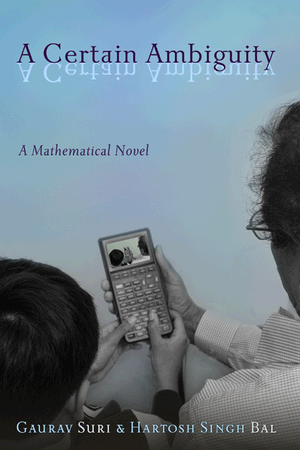
A Certain Ambiguity -- Book Review


When I saw the subtitle which is “A Mathematical Novel”, I wanted to close the book.  But it sounded interesting so I read it.

The novel is good since fiction was incorporated with mathematics. Mathematics was all about truth, accuracy and proof but the novel was able to incorporate fiction in it. It can be read by the general public since it is easily comprehensible.

The story has a very good plot. Students would love to read it since a dramatic story about the grandfather and his son is there.  I thought it would be hard to incorporate mathematics and all these mathematical ideas in the story. But the authors were able to blend the mathematical ideas with the dramatic tension which makes it really good.

The novel takes you back in time where mathematics was being established and evolving. The novel discussed about infinity, set theory, Euclidean and non-Euclidian geometry.

I like the character Nico who is a professor of mathematics because he is a very motivating teacher. He encourages his students to be able to have a deeper understanding of his subject. He also knows how mathematicians mind work.

All in all, the book is highly recommended. Even if you are mathematically illiterate, you could understand the book and you could actually learn something from it. For me, it made me think about the philosophical insinuation of the basic math axioms. I was fascinated by the journey of the young man, Ravi. While the story isn’t really believable, it is fun to read and educational at the same time.

A Certain Ambiguity: Book Review

Most books that you find that has the subject mathematics in it usually are usually for educational purposes. But this novel is not only compelling, plot wise, but the beautiful and rich mathematics that was woven perfectly with the storyline. It truly is a unique approach to finding certainty to the world of mathematics and philosophy.
            Mathematics is commonly known to be the doorway to absolute truth and certainty. This book made a good job on presenting that idea, that through pure reasoning and logic we can achieve greater knowledge. Math is the closest thing we can get to achieving absolute certainty. However the book also does an excellent job on connecting the pure and concrete math with the irrational and unreasonable human condition.
            Many theorems were discussed such as Zeno's paradoxes and infinitude of primes through Godel's Incompleteness and Paul Cohen's Consistency theorems. One can safely assume that the authors have some kind of degree in math. But the discussion of these mathematical models isn’t what makes this a unique book but rather the human/emotional side of mathematics, which is ironic since, stated before, math is concrete and logical. As any content in a novel the rich story maintains the readers interest but the authors spiced in deep mathematics. As someone who isn’t keen on mathematics there might be some mathematical passages which are a bit difficult or abstract to fully understand, but the book doesn’t put in like a PhD dissertation but just presents the passages as is.

            You could argue that is a new genre, a novel with a captivating plot and beautiful story line yet has a rational mathematical and philosophical side. It’s a beautiful piece about its relevance to the human understating of the surrounding world.

Love at First Calculation

Love at First Calculation
A Book Review on G. Suri and H. Singh Bal's. "A Certain Ambiguity"

It has been a long time since I have actually read a novel. This book struck me in two ways: (1) the cover says its a mathematical novel, and (2) I have never read or seen a mathematical novel. Why? Maybe because it never picked my interest before. When we see or hear the word 'Math'. usually, the first things that come to mind are numbers, calculators, formulas, reference books, etc. So, it got me thinking, how could mathematics be incorporated in a novel and now that I have a chance to read such new genre (for me), I figured let's do it.

The book started with a flashback of our protagonist, Ravi Kapoor, when he was still with his grandfather,Vijay Sahni, who introduced him to the beauty of Mathematics. At a young age, his grandfather, who he calls 'Bauji', gave him a mathematical problem for him to try to solve on a calculator which eventually led him to discover his fascination with hidden patterns in solving as well as in the environment. Working with the given problem insinuated a desire for him to know more about the mathematical world that when his grandfather died, he did not stay mourning over their family's loss. Instead, he went into Bauji's room and listened to his songs for quite a time. It is important to note that in the single instance that Bauji gave Ravi a mathematical problem, Ravi discovered what he wanted and pursued his dream, further exemplified by his roommate when he was admitted to Stanford.

Ravi majored in economics in Stanford. He made friends with his course professor, Nico, who specializes in the field as his grandfather. Not long after that, the story splits into two directions: Nico's lecture involving infinity and its remarkable role in Mathematics and Ravi's discovery of his grandfather's philosophical discoveries of the truth in nature while he was in prison.

We now understand that, basically, Mathematics is built from philosophies of great minds. This novel contains a wide discussion of the theorems and philosophies in the subject. I felt like reading a diary. Ravi eventually pursued a mathematical career and got married. There were ups and downs while reading the book for me. But one thing is for sure: the authors have successfully incorporated Mathematics and its concepts in a novel. A Certain Ambiguity is certainly a very informative read.

Then, Now, and Forever

So, it has come to me that The Story of Maths has ended and, of course, I won't say goodbye to it without reviewing the last episode entitled 'To Infinity and Beyond' (Buzz Lightyear, is that you?).

The last episode opened with David Hilbert presenting the 'twenty-three most important problems for mathematicians to crack' that became the foundation of 20th century mathematics. His first problem was centered on Georg Cantor's work, the first person to understand and explain infinity and developed the Continuum Hypothesis. A contemporary by the name of Henri Poincaré, who believed in Cantor's ideas, participated and won in a competition proving if the solar system would continue to work like clockwork in the future. His idea never did answer the objective of the competition but his techniques indirectly led to his Chaos Theory. Relating to Poincaré, a Russian mathematician named Grigori Perelman was able to solve a problem that even its discoverer could not fathom. This problem was the Poincaré's conjecture. Another one who was influenced by Cantor would be Paul Cohen; though, that would take numbers of years later.

David Hilbert had created an abstract approach of mathematics and believed that maths is a language powerful enough to find solution to his twenty-three problems. But, his belief was shattered when an Austrian mathematician brought uncertainty to the world of maths. His name was Kurt Gödel and he developed the Incompleteness Theory. Another one of Hilbert's problem, specifically the 10th problem, became the lifework of Julia Robinson, the creator of the Robinson Hypothesis. She was unable to find an answer and this gave Yuri Matiyasevich bring closure to her work.

The last part focused on the idea of Évariste Galois that maths is a study of structure and his application of geometry to analyze equations gave path to the introduction of Algebraic Geometry by André Weil. He and Alexander Grothendieck contributed to the conception of the influential Nicolas Bourbaki, pseudonym for French mathematicians who wrote accounts of the 20th century maths.

The documentary The Story of Maths unveils the birth of mathematics from the ancient times, its flourish in the Age of Enlightenment, and its continuous development in the modern era. Not to be overlooked, the documentary also presented the ups and downs of maths and the persons responsible to the wonder that is maths. With new concepts and ideas being developed with the flourish of maths, there are still problems unanswered. You never know, the person who would be able to unriddle Hilbert's eighth problem, the Holy Grail of the world of maths, is someone among us.


An Epic Search For Truth


As someone who has a rudimentary knowledge about mathematics, I have found the book to be an “easy read” as per the first few chapters. But as the story goes on, one will discover what really lies within this book. Intellectually and emotionally overwhelming, “A Certain Ambiguity” is a novel creating its own genre and hitting the reader deeply to his nerves; yet written in a light manner so the general public can understand.
The book was a work of fiction having a captivating plot that worked well with discussions of mathematics, skepticism, religion and philosophy. It starts with a nostalgic flashback of the young Ravi Kapoor delighting in play of numbers and logic together with his grandfather, Vijay Sahni, who is an Indian mathematician. Later after the death of his grandfather, he was accepted into the prestigious Stanford University in US and majoring in Economics. Instead of getting the right subjects for him to graduate on time, he suddenly takes on a class called “Thinking About Infinity” where he learns a lot more than he expected. He learns not just about analyzing infinity. Outside the class, he also discovered revelations regarding his grandfather’s past by the help of his friends and colleagues. These intertwined events alongside with odd collection of characters set up a philosophical examination of the nature of reality, faith and certainty in religion, mathematics and life.
Further, the novel poses a lot of mathematics and philosophy, including the combination of the two. While the story and characters are fictional, real mathematical proofs like the Pythagorean Theorem and Euclidian geometry were presented in an interesting way. The authors also attempt to bring in some of the history of mathematical certainty like entries from Pythagoras, Oresme, Cantor, etc. The novelists do note though that the inscriptions are merely fictional and explained on the history in a section of notes at the end of the book.
Though mixed up, the philosophical connections to mathematics were clearly developed and very agreeable. This book accomplishes a good job of justifying faith to people with rational and mathematical views of life. Should the novel change your view of life, but will make you some inquisitive thinking on crucial topics.
Overall, I loved this book and would highly recommend this masterpiece to everyone. Yes, this is purely fictional; but the authors have succeeded in presenting mathematics as a human endeavor and making the readers think hard on the metaphysical implications of basic math axioms. One couldn't ask more of such a delightful and informative read.

Wednesday, January 29, 2014

to infinity and beyond -- Story of Maths Part four

               Infinity, it is a nonfigurative concept which describes something that is without limits, boundary. For me it is irrelevant since you can’t see, you could only imagine it. How can something unseen and is only imagined been important to mathematics? It seemed like the word “infinity” has been used only as a noun to describe physical entities which are considered to be infinite.
               The 4th and last episode of the Story of Maths discussed some of the immense unsolved problems that tackled mathematics in the 20th century and told the stories of the mathematicians who tried to work them out. In this episode, the concept which was avoided by many mathematicians was explored—infinity.
           In the movie, Marcus du Sautoy explored Georg Cantor’s work on infinity as well as Henri Poincare's work on chaos theory. Cantoy found out that there were different kinds of infinity. Poincare’s case was quite amusing since he was trying to solve a mathematical problem but he accidentally fell on chaos theory. This has led to a variety of machines and technologies.
          Marcus du Sautoy then discussed the discoveries and important contributions of other mathematicians. Kurt Godel, who is a member of the ‘Vienna Circle’ of philosophers illustrated that it was not possible for mathematics to establish its own consistency and that the unknown itself a vital part of mathematics. Another mathematician was mentioned in the movie—Paul Cohen. He proved that there are many different sorts of mathematics in which contradictory answers to the similar question was possible. The algebraic geometry developed by André Weil, along with his colleagues was also examined. Algebraic geometry is a very important field of study since it helped solve many mathematical equations like Fermat’s Last Theorem.  Another one is Alexander Grothendieck whose ideas had a big influence on the present mathematical views about the unseen structures behind all mathematics.
He also reflects on the contributions of Alexander Grothendieck, whose ideas have had a major influence on current mathematical thinking about the hidden structures behind all mathematics. Marcus concludes his journey by considering the great unsolved problems of mathematics today, including the Riemann Hypothesis - a conjecture about the distribution of prime numbers – which are the atoms of the mathematical universe. There is now $1 million prize and a place in the history books for anyone who can prove Riemann’s theorem.
               He concluded his voyage by considering the great unanswered problems of mathematics today. One of these is the Riemann Hypothesis which is a hypothesis about the allocation of prime numbers. A million dollar prize and a place in history books await anyone who can prove the Riemann's theorem.
               Even though this movie was the last part of the series it proved that there is still more things to learn about math. And I think infinite number of movies will be needed to fully unveil mathematics.
               Mathematics really is a very important discovery of humans. It is a product of the collective effort, curiosity and intelligence of not only the know mathematicians but everyone who uses it. it is amazing how mathematical ideas supported science, technology and cultures that shaped our world.

               Because of the series “Story of Maths” a big part of mathematics was unveiled and I believe there is still more to be learned and discovered.

Tuesday, January 28, 2014

The Frontiers of Space


     The third installment of the story of maths talks more about perspective and the discovery of more things about mathematics. This episode focuses on the mathematicians from Europe and how they discovered things like calculus, geometry, imaginary numbers and others.
     
     The introduction starts off interestingly which defines the whole point of this episode which is perspective and space. The professor starts his introduction with a painting which is the Flagellation of Christ by Pierro della Francesca. He explains how brilliant Pierro is just by looking at this painting. Pierro applied mathematics to create a 3D perspective in a 2D canvass. This is just one example to what the professor said that masterpieces of art are also masterpieces of mathematics. With the use of mathematics, a new perspective was made and this explained a lot about mathematics.
    
     The professor said that northern Europe is the powerhouse of mathematical ideas. One of which is Rene Descartes who discovered the link between algebra and geometry. Next is Fermat who discovered the modern number theory. This episode also presented that Isaac Newton did not only contribute to physics but also to mathematics. He discovered calculus. But shortly after his discovery, another mathematician, Gottfried Leibniz, was also able to discover calculus. During this part of the episode, I thought that publishing your discoveries is also important to give credit to him it should have been. In the later part of the episode, there were also other mathematicians that did not publish their discoveries. They were not credited for what they have discovered first. One mathematician even went crazy because of this. So, I thought, publishing discoveries was also important if you want due credit for what you discovered and this will avoid conflicts in the latter part.
     
     This episode named a lot of famous mathematician and their discoveries. I would not name them one by one since it would seem that I only summarized the movie. The important thing we should remember from this episode is that the European mathematicians have contributed a lot to what our world is now today. As what the professor said, “Without this golden age of mathematics from Descartes to Riemann, there will be no calculus, no quantum physics, no relativity, none of the technology used today.”

Monday, January 27, 2014

Infinity, Mathematics and its Never Ending Study

Infinity is the concept that has puzzled mathematicians and thinkers alike for years. And this continues and will continue for the succeeding years. Too many questions out of curious minds that are needed to feed with answers, and eventually reveal the underlying truth regarding this ambiguity.
But really, what is infinity? In mathematics, infinity is simply defined as something not finite, hence it is endless. Mathematicians have defined “infinity” very closely but not exactingly. The notion for this can be considered as profoundly outside the human ability to understand. Even so, this has not stopped mathematicians from solving and finding certainty.  After all, the hunger to explore and delight in discovery is what makes us human- living and surviving.
The fourth episode of the Story of Maths entitled “To Infinity and Beyond” is an existing example of the saying “last but not least”. This final installment talks about the core study and highlights of 20th century mathematics that has started with the assembly of International Congress of Mathematics in Sorbonne, Paris during 1900. One of the leading mathematicians of his generation, David Hilbert, has outlined a list of 23 unsolved problems (at that time in) which he called upon the attention of his colleagues. He revealed vital questions that opened areas of research that has spanned different branches of mathematics for the future generation.
Hilbert’s problems were highly influential  for the 20th century study of mathematics. The problems overlapped several areas of mathematics; involving set theory, geometry, arithmetic, algebra, variable calculus and many more. Some of these were direct and thus immediately solved. Some problems, on the other hand, were vague and expansive that until now they still remain unresolved.
One of the theories (problems) needing for proof was proposed by Georg Cantor, a German mathematician, whom was the first to give mathematical accuracy and precision to the concept of infinity; and provided different types and sizes of infinities through his Continuum Theory. Another problem that had confused mathematicians during those times was regarding the orbits of planets in our solar system. This has led to the basis for Chaos Theory by Henri Poincaré, a French mathematician. Observing systems with a multiplicity of variables, this theory had been a great function in studying climatic conditions and applications in medicine. Further, showing any logical system that would result to true but cannot be proved statements, as done by an Austrian mathematician in the name of Kurt Gödel had revealed uncertainty through his Incompleteness Theorem. 
Undeniably, mathematics is not like a complete textbook as being taught and learned in schools. The subject that was once been defined had evolved through history became into the greatest abstract ideas that the human mind has encountered. Among all of these abstractions, uncertainties and infinities, the study of math will never be ended. Every proved theory would just lead into creation of other theories; unanswered questions into answers and answered ones to be questioned logically. Scholars and even ordinary people like math's challenges and at the same time its clarity- the point when you know when you are right! Finding a correct solution to a problem is not just satisfying, but at the same time exciting.
After watching and completing the documentary series "Story of Maths" here is my brief generalization:
The ability to count, compute, measure, study shapes and motions, and use numerical relationships by logical reasoning with a bit of abstraction, are the supremely significant among mankind’s achievements. Mathematics is not the creation of a single person but the product of gradual and social evolution. It all started as providing practical solutions for everyday problems for as far as written records exist. The Greeks then first used logic in making generalizations. On the other part of the world, most notably in China, India and other Muslim places, mathematics continued to develop. Until the 17th to 19th centuries mathematicians have started to take mathematics into a higher level. The 20th century study of this field was even more advanced; giving rise to technologies and innovations that continues to the present day.
The study of mathematics is not just mystifying because some of us find it too complex to fathom. It is the basis of the universe, allowing us to fully understand the physical world. 

Sunday, January 26, 2014

The Frontiers of Space

BBC Story of Maths part 3                                                                                                          The Frontiers of Space


            In the 17th century, Europe replaced Middle East as the engine house of mathematical ideas. Europe became the powerhouse of mathematics of objects in motion. Marc de Sautoy started with introducing the concept of perspective through the mathematician and artist, Piero della Francesa's, work.

            The movie then proceeds to other big names in mathematics like; Descartes, who merged the ideas of geometry and algebra; Pierre de Fermat, who virtually invented modern number theories, was Descartes rival; Isaac Newton who was known more for his physics contribution and not for his mathematical ideas; Gottfried Leibniz who discovered calculus shortly after Newton; the Bernoulli family who were defined as Leibniz’ disciples; Leonardo Euler who de Sautoy marked as the “Mozart of Maths”; Friedrich Gauss who invented the imaginary numbers; and a lot more.

            The third installment of the story of maths was interesting to watch. I did not know there were controversies or dramas during the process of math’s discoveries. Newton and Leibniz did not want to share the credit in discovering calculus hence some misunderstandings. And here comes the Bernoulli family who were Leibniz’ number one supporters. They were on Leibniz’ side and spread his ideas (lol fanboys). Later on, Lebiniz’ ideas triumphed because Newton’s approach was more complicated.


            I find it interesting that these great mathematicians all had difficult childhoods and yet, they have the greatest contributions in the mathematical world. Nothing stopped them in doing what they wanted and for that, I truly admire them. Their passion is truly amazing. Not only did they contribute a lot to the modern world, but they also serve as a great inspiration to everyone, especially to us, students. 

The Pursuit of Greater Knowledge

The Pursuit of Greater Knowledge
A movie review on BBC The Story of Maths: To Infinity and Beyond

            After hundreds of years of developing Mathematics and discovering more of our natural world through mathematical philosophies, we finally arrive in the current status of the number world where unsolved problems are faced head-on by twentieth century mathematicians. It seemed like the Egyptians, Babylonians, Chinese, Arabians, Leibnitz, Newton, and many other people who shaped the mathematical world have contributed enough to provide the structure for us to use in our everyday lives. However, how sure are we that they did not leave any question unanswered? In this last installment of the four-part documentary of the BBC Story of Maths, Marcus du Sautoy takes us once more a little bit back in time to explore how these most recent mathematicians tried to work out great unsolved problems that the most excellent minds may have intentionally avoided.

            David Hilbert proposed 23 unsolved mathematical problems that he felt important that it must really be solved. Later on, his agenda was approved and the task to find the answer to his first proposed problem started. Georg Cantor studied the concept of infinite numbers. He compared infinite whole numbers to the smaller set of numbers. He, then, reached a conclusion that the compared infinite sets have the same size but vary in the decimal conversion of the infinite numbers. Because of this variation in infinite decimal numbers, he found out that there are types of infinity, some bigger than the others, by showing that there is a continuous missing decimal number in the conversion as he progress with the infinity sequence. Still, there is a loophole in the solution: the possibility of an infinite set between infinite sets. This is where the Continuum Theory was born stating that there is no such set. Another problem was developed from ‘Bendy Geometry’ or the concept that says, if two shapes can be moulded to be another, then they have the same topology, in the two-dimensional sense. The problem in this discipline is the identification of shapes in a three-dimensional universe. Grigori Perelman gave answer to that question. He looked at the discipline in another mathematical point of view and thus, he found ways that 3D can be manipulated in higher dimensions.

            We now know that mathematics is a universal language, a language enabling everyone to team up to find truths in our natural world proven for hundreds of years already. David Hilbert believed that too. But an active member of the “Vienna Circle” has disproved that idea. Kurt Gödel showed that the consistency of mathematics is impossible to prove and thus, there is always the unknown as an integral part of mathematics.


            As the documentary reached an ending, the learning gets more entertaining maybe because, as it gets closer to the modern math, I, as a student, can relate more to the concepts and/or ideas presented. More issues were formed; more discoveries were found. One problem may have conflicting answers and certain answers solve some theorems. Together, with everything else in the world, we move forward. There are still more unsolved problems out there and it only takes one step to start the journey to find the solution, to seek the truth, behind the unknown. It may not be easy but just one step, one step to start the pursuit of knowledge to infinity and beyond.

Saturday, January 25, 2014

TO INFINITY AND BEYOND :p


 24-JANUARY-2014


“TO INIFINITY AND BEYOND”


The Story of Maths is like awakening the history of world. From what drives the people to discover math and how it develops through time that helps us to understand everything around us. The last episode was all about the 20th century math, the modern mathematics. The film started by saying “Mathematics is about solving problem and the great unsolved problem makes the maths really alive.


The 20th century mathematicians are inspired on solving the unsolved problems of previous famous mathematicians. By the quote of David Hilbert “We will know, we must know” that drives the mathematics into proving more the cannot be proved problems.


State for example, George Cantor who really understand the concept of infinity and he made a hypothesis called Continuum Hypothesis though it wasn’t really proved but later part of the century a young mathematician got interest on it and later proved the hypothesis was correct. Another example was David Hilbert hypothesis, up until now many people still uses his concept and many still trying to proved it more like the 10th Hilbert problem, Robinson tried to understand it but it was proved by a young Russian mathematician who was inspired by Robinson.


The Incompleteness Theorem drives me into something. Its different from other theorem because it contradict the statement itself. Kurt Godel thinks that any logical system for mathematics there will be statement about numbers which are true which you cannot proved and that if the statement is false that means the statement could be proved its a contradiction. Its sort of complicated to me but that’s depends on how the mathematicians wants to solved their problems, it comes with different styles.


In order to learn and discover mathematics we must look to is history. Up until now lots of mathematicians going back and reproving the doubted hypothesis and making new hypothesis that much easier to understand. And what they say its true about mathematicians that they are not motivated by money, material gain or even the practical applications of their work that for them it is the glory of the unsolved problems of the previous great mathematicians and that mathematics is really the key to the universe.

Thursday, January 23, 2014

The Mathematics of Life Book Review


The Mathematics of Life


The book first stated that biology had 5 great revolutions : inventing the microscope; systematically classifying the planet's living creatures; recognizing evolution by natural selection; discovering the gene; and determining the structure of DNA. But the author proposed another great revolution: mathematics.

 Mathematics already took part in early science such as in physical sciences and biology even. Mathematics merely took part in gathering data and calculating results. But now biologists are using mathematics more often to make new discoveries and understandings. An early use of mathematics in biology was in 1950s when Alan Turing proposed that a process called biochemical-diffusion could give rise to coat patterns we observe. He used mathematical models to record the result of the coat patterns. The author also suggested that mathematics has played an important role in understanding viruses. More specifically geometry was in aid when it comes to the definitive structure of viruses. Different shapes and dimensions, calculations that we use in trigonometry were used, different theories was used in studying viruses on how to find its weakness and its weak spots.

The authors discussion on linking biology and mathematics is captivating but the problem is he didn’t overlap each topic and tying them all together making it quite confusing for other readers. At times the book may be frustrating for some ideas may be quite monotonous and repetitive, not good for those casual readers. The first five revolutions adhere well with the sixth but the author suggests that there may be more frontiers and revolutions to emerge.

Wednesday, January 22, 2014

From Europe with Love


   The third installment of the story of maths explored the Golden Age of Maths; shifting from the Middle East to Europe.

   By the 17th century, Europe took the crown from the Middle East as the powerhouse of mathematics. Discoveries churned left and right, with some ideas overlapping one another. Few have also intertwined mathematics with different fields of knowledge, such as art.

   This period in mathematical ideas saw the emergence of great mathematicians. The artist Piero della Francesca used mathematics in his painting and introduced perspective. Rene Descartes made it possible for algebra and geometry to merge. Pierre de Fermat discovery later led to the modern number theory. The discovery of calculus caused a rift between Isaac Newton and Gottfried Leibniz. In the end, the Royal Society credited Newton as the first discover and Leibniz as the first publisher.

   Interestingly a family of mathematicians place high in the world of maths. Two members of the Bernoulli family were supporters of Leibniz's idea and eventually developed the calculus of variation. Leonhard Euler, a student of Johann Bernoulli, popularized the mathematical terms e, i, and π. Euler is considered as the father of topology or 'bendy geometry'. Carl Friedrich Gauss, the 'Prince of Mathematics', was the first to explain imaginary numbers. At a young age he was a genius; challenging Euclid's The Elements and having ideas hundred years ahead of his time. Another young mathematician, Janos Bolyai, studied imaginary geometries, later known as hyperbolic geometry. He was devastated when he learned that a study containing the same idea as his was already published two years prior by another mathematician named Nikolai Lobachevsky. Last but not the least, with knowledge from the foundations of geometry, Bernhard Riemann discovered that objects can exist in higher dimensions of space.

   The shift of attention from Middle East to Europe brought many great tidings to the world of maths. I can truly say that it was indeed the Golden Age of Maths with the number of discoveries and their corresponding escalated difficulties the mathematicians contributed. Their passion for knowledge and mathematics is truly amazing.